
A catalyst for conversations? A ‘natural law’? Bringing the Arc of (nearly?) Everything© to coaching conversations can unlock profound insights and effects for individuals, teams, and the wider world, says Neil Scotton
More than 20 years ago, I was on a leadership programme exploring personal patterns and behaviours as part of self-development. A curious saying came up: ‘A weakness is a strength overplayed.’ It intrigued me. ‘How does that work?’ I asked myself. As an engineer (at the time) I liked to see things visually. And I found a simple graph did the job.
As my life and career evolved further, working with individuals and teams in coaching and leadership development situations, I began sharing this graph more. Over this time, I found myself asking: ‘Is there anything that it doesn’t apply to?’ Currently I share or refer to this several times a week in conversations with clients. And over the years I discovered some deeply profound implications. So, what am I talking about? Well, here it is (Figure 1).
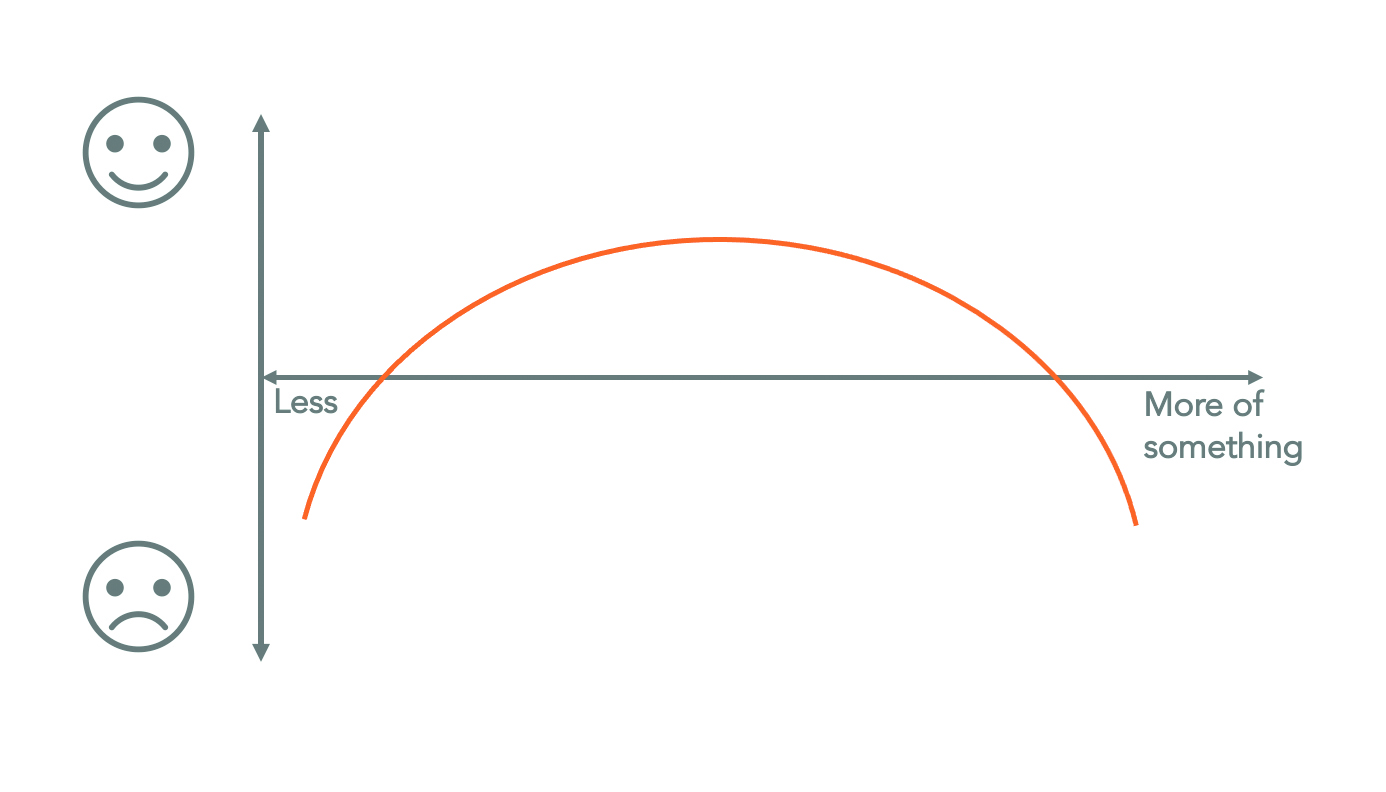
Fig 1: The Arc of (Nearly?) Everything©
A new way to encounter an ancient wisdom
You can see how this turns up in many familiar phrases: ‘A little of what you like will do you good’, and ‘You can have too much of a good thing’, for example. There’s ‘A time for everything’ in Ecclesiastes in the Bible (3: 1-8), and in the Buddhist frame it’s about ‘the middle way’. I could go on.
If we start by looking at basic human needs, it’s easy to see how it works. Here are some extreme examples to make a point. In Figure 1, too little water (left hand side) and you die of thirst, too much (right hand side) and you drown; too little food (left) and you starve, too much (right) and you become obese; too little oxygen and you suffocate but in high amounts you burst into flame. And somewhere in the middle of each – it’s great!
OK, so what about aspects of human nature? Well, you can choose what you like. Here are a couple of examples:
Too little courage and you’ll shy away from things, too much and you become foolhardy.
Too little creativity and problem solving will be difficult, but too much and you may be forever chasing ideas and never actually getting anything done.
You can keep going with whatever you want. How about assertiveness? Boundary setting? Forgiveness? They all have potential for too little and too much. And a place in between that where it can work wonderfully.
My Tai Chi instructor, Paul, had a phrase he used a lot to answer people’s questions about pace, position, stretch etc: ‘No more, and no less than is necessary.’ So true. There it is in a nutshell.
Applying the Arc
Let’s play with a few more examples…spend too little money on something and you’ll probably have something unreliable that breaks easily, but there’s also ‘a point of diminishing returns’ and simply spending more doesn’t lead to ‘better’ in any significant way. You might simply be paying too much. The same is true for ‘how much time should I spend on this?’ Too little and do it badly, too much and you’re missing out on other things. And how much effort should I put in? And how much should I listen? Or speak? And so it goes on: too little, too much, and flourishing in between.
In professional coaching
So how is this useful to a professional coach? Here are a few real examples:
A client is torn about whether to take a new job. The conversation reveals that they have a core value around loyalty. They look at the graph and realise that they are overplaying that value. They go on to tell me that they now realise that they should have left the present role years ago.
A deeply caring and considerate team is exploring the unhappiness and tension it’s experiencing. Being there to support each other is a core value and strength to team members. They look at the Arc, and realise they collectively are being too forgiving, too accommodating, and not doing enough holding to account, positive challenging and inviting personal responsibility. They work out how they’ll know when they can move towards the top of the curves for each of these.
The Arc doesn’t require someone else’s model of teamworking or performance or anything. Or someone else’s list of prompt words. Or anyone outside saying what is or isn’t the right thing to do. Clients and a coach/thought partner/observer paying attention to what’s happening and reflecting back is more than enough.
You can use it for clients exploring balance, personal well-being, more sustainable ways to live and work, dealing with overwhelm, understanding a baffling frustration, getting more done for less time and/or effort, etc.
Dealing with the negatives
So much for the positives. What about the parts of myself that I don’t like? Can it help bring more peace there?
Well, yes. For example…What if I’m struggling with ‘Worry’? I look at the Arc and ask myself ‘Where am I on this?’ Maybe I’m far to the right hand side. I may be thinking, ‘I don’t want to worry’. But as I take on the wisdom of the Arc, I recognise that there’s also a truth in the problems I could experience if I didn’t have enough worry. If I didn’t worry about anything I could get into terrible, foolish, and naive situations. Some worry helps ensure I check things. I prepare better. I make safer choices. So now I don’t frame worry as a ‘bad’ thing. Too much is bad. Too little is bad. In the right amount it helps me. We can be friends. When I spend time with my worry in this space there is no fight. We work out how to get along.
Putting aside thoughts of client work, it can be important to walk your own journey with this. I’ve found it has gradually, subtly, enabled my life, my work, and my whole self, to become much more aligned. Things seem to happen more easily and generally be less contentious, and less stressful.
This thing just keeps giving.
Let’s introduce a couple more ideas (see Figure 2).
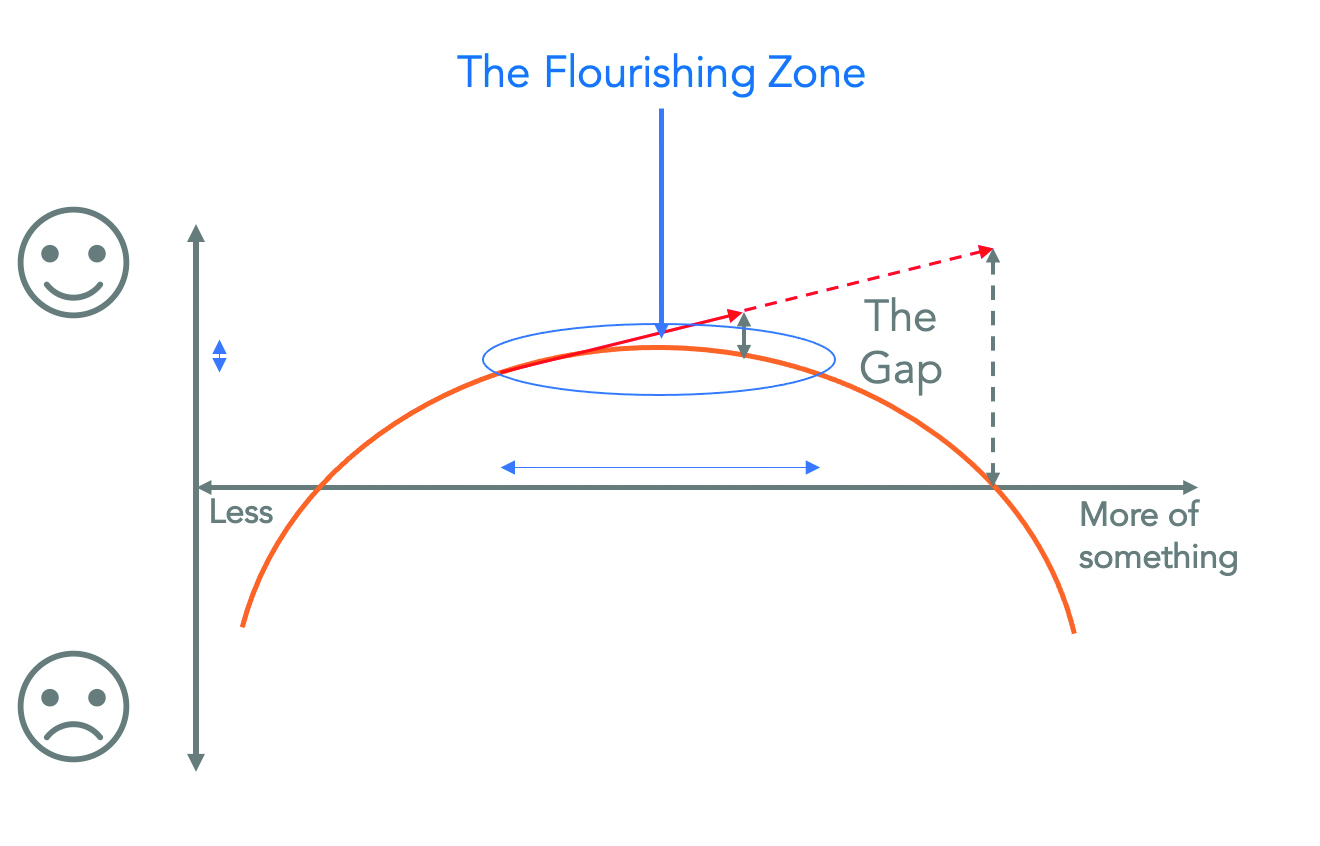
Fig 2: The Flourishing Zone
The Flourishing Zone
When first sharing this with others I described it as ‘The Flourishing Point’ – bringing attention to the peak of the Arc (Figure 2). The wonderful coach Rashmi Shetty put me right on that – in the middle you can often move across a wide range on the horizontal axis (what you’re doing) and yet notice that the vertical axis (what you want) doesn’t move much at all. Or put another way – anywhere in that zone is good enough for most purposes.
Trying to be precise about the very peak of the peak can reveal if you and/or the client have something going on about perfectionism (in fact you could use the whole x -axis for perfectionism – too little and you’re sloppy, too much and there’s all sorts of unnecessary stress and costs). By the way, the same is true when you look at any of the possible y-axis (vertical) qualities – happiness, success, health, etc – shift them onto the horizontal axis and notice that (on the left) if you don’t pay them any attention you’re likely to have problems, (and on the right) if you obsess about them you’re also likely to have problems. For these things there’s a right place in between too.
The Gap
Two forces seem to work on us – when we do something and it works, we seem to think that doing more of it will keep delivering more of what we want, eg, If I can earn £x in hour with a client, then if I do two hours a day, I’ll earn £2x, and four hours I’ll earn £4x, and 8 hours five days a week I’ll…um…fall over, lose all my clients and be completely useless. More does not always lead to more. In fact, if it’s a natural law, the Arc suggests that there will always be a point where ‘more’ becomes ‘too much’.
So, if we think we’re moving ever upwards on a straight line, but reality is following an arc and productivity/happiness/whatever we’re measuring ‘what I want’ by is now falling away, we experience the unsettling dissonance of ‘I ought to be this happy/productive/whatever, but actually I’m down there!’
I notice that people’s response to this is often ‘try harder/go faster/keep at it longer’, and to keep trying to follow the line. The Gap gets bigger, the dissonance more obvious and more painful.
When you present the Arc to a client who’s been behaving with the belief that ‘more brings more’ and is wondering why they’re unhappy, exhausted or have lost their mojo, and ask, ‘Where do you see yourself on this?’, the lights come on.
Opening deeper conversations
Working as a coach, especially in these times of great division, the principle of ‘client’s agenda’ is important. But we also have ethics and values of our own we may wish to embody in our work. One of the things that fascinates me is that I never have to worry about this potential conflict. I just leave myself out of it. The Arc is something that invites people to think – it doesn’t tell them what to think. Any conflict happens within the client as their beliefs, experiences, insights and feelings process what’s going on. They find their answers themselves.
Five Freedoms for the client
With that in mind, I’ve recognised there are Five Freedoms that it’s really important to offer a client:
1. Let them decide what they’re applying to the x-axis (the horizontal one)
Often, they’ll be looking at it ranging between less and more of something. It’s important that they choose the word. AND ALSO… some people work in dualities. So, they may be wondering about their balance between fun and something else. Maybe it’s between ‘Fun’ and ‘Effort’, or ‘Fun’ and ‘Discipline’ or ‘Fun’ and ‘Dull’ or… It’s important to let them choose the words, according to their map of the world. And then together you can explore what the Flourishing Zone is between these two. In a coaching conversation this can be rich with insights for the client.
2. Let the client decide what the happy and sad face mean to them
Some might see this y-axis as a scale of happiness. But others might be seeking fulfilment, peace of mind, productivity, recognition, money or success (and what success means for them). This shines a light on how the client is navigating through work and life.
One interesting note here is when a client recognises that they’re making some decisions in some parts of their life to maximise one thing (eg, happiness), and in another something else (eg, money). They see how this might be a source of their conflict.
3. Let the client decide the shape of the curve
Does the client’s curve rise quickly or slowly? Is there a long flat peak or is it sharp and precise? How quickly and when do things fall away for them for whatever they’re looking at? This is another example where your map of the world and theirs can be very different. People love to explore theirs.
4. Let the client decide what their Flourishing Zone is
How precise do they have to be to get what they want to experience? What is the range they can be flexible between?
5. Let the client decide what the Arc doesn’t apply to
It’s called The Arc of (nearly?) Everything for a reason. People are likely to have things where the only answer is None, or Never or Always. You may want to explore this for yourself – what, for you, doesn’t have an Arc of getting better then getting worse the more of it you do/have/apply/receive?
What does this say about ‘good’ and ‘bad’?
As Shakespeare wrote, “There is nothing either good or bad, but thinking makes it so” (Hamlet, Act 2, Scene 2). Applying the wisdom, or natural law if you wish, of the Arc we can see that pretty much anything can be useful in the right amount at the right time – and it always has the potential for too little or too much. So, for example, compassion is great and much needed in the world, but those involved in caring professions have shared their experiences of pushing this so far that the personal cost has been huge. And, of course, everyone is free to say, ‘This doesn’t follow the Arc.’ After all, it’s for (nearly?) Everything…
What about conflicting ideologies, dualities, and yes/no thinking? I’ll leave this to you to explore. In one sense this gives a clear message. But it’s important that people explore this themselves, and remember the Five Freedoms, rather than being told what to think.
About the author
- Neil Scotton is all about enabling powerful change in gentle ways. He coaches, writes, shares stories, walks, grows veggies, plays guitar, does tai chi, and hugs his family.A professional coach for more than 20 years, he works internationally supporting people who are up to good things in the world and those embracing rich, meaningful, fulfilling lives. He’s increasingly known for sharing free things that enable deeper and often life-changing conversations, eg, see neilswheel.org and for his poetry, neilscotton.comWhen not working you’ll often find him amongst trees, by lakes and sitting watching the birds and the sky.